
Global 5G Fixed Wireless Access (FWA) subscriptions are set to more than double by 2030, according Omdia’s latest report, 5G FWA Go-to-Market Strategies – 2025.
Global 5G Fixed Wireless Access (FWA) subscriptions are set to more than double by 2030, according Omdia’s latest report, 5G FWA Go-to-Market Strategies – 2025. The research highlights strong momentum across key markets led by India and the United States and identifies FWA as the fastest-growing broadband access technology.
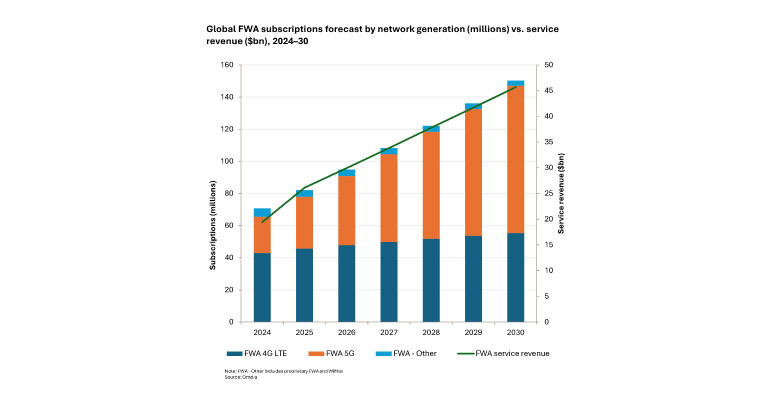
Omdia forecasts global FWA subscriptions to grow from 71 million in 2024 to 150 million by 2030, accounting for 88% of total connections. The 5G FWA segment is projected to expand at a 23% CAGR, driving total FWA service revenues to $46 billion by 2030, as premium 5G offerings capture a larger share of the market.
“Tier 1 operators must evolve beyond legacy deployment models and embrace segmentation, bundling, and AI-driven personalization to monetize 5G FWA effectively,” said Nicole McCormick, Chief Analyst at Omdia.
Regional Growth Highlights
- India is set to become the largest 5G FWA market by 2030, reaching 37 million subscriptions, representing 40% of global share and fueled by Reliance Jio’s aggressive rollout, supported by AI and digital twin technologies.
- The United States will remain a key market, reaching 20 million subscriptions, as operators expand their broadband footprint through diversified FWA offerings.
- Nigeria, Italy, and Japan are expected to join India and the US as the top five 5G FWA markets by 2030.
- Central & Southern Asia, Africa, and Latin America are emerging as high-growth regions, supported by falling CPE prices and innovative bundling strategies.
- The report also notes Quality of Experience (QoE) is becoming a critical differentiator in 5G FWA offerings. Tier 1 operators are increasingly upselling based on service reliability, latency, and user-specific performance - particularly for gamers, remote workers, and video streamers - rather than relying solely on speed.
Omdia’s report finds 5G FWA will surpass 4G FWA by 2027 and is on track to overtake DSL as the world’s third-largest broadband technology. With cable modem subscriptions expected to decline, FWA is positioned to become the second most common broadband access technology post-2030.